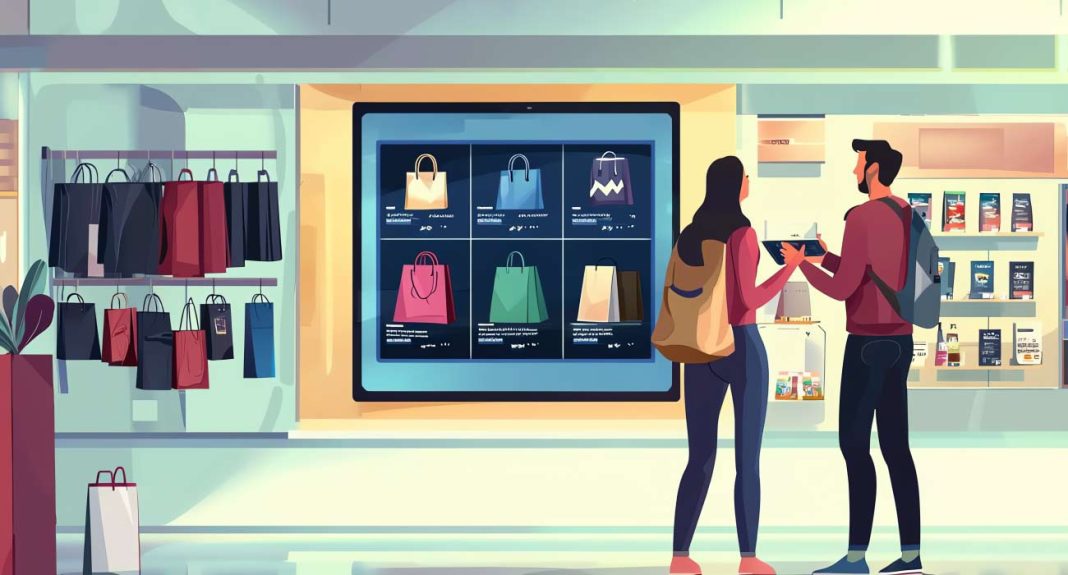

In-store media is redefining retail. With screens, sensors, and data, physical stores are turning into performance channels that rival digital for ROI.
Retail media has quickly become one of the fastest-growing areas of advertising, reshaping how brands connect with consumers. While much of the conversation still centers on online channels, physical stores are joining the landscape through in-store digital signage, smart displays, and interactive kiosks – technologies that turn every wall, aisle, and endcap into a measurable media environment, delivering both engagement and insight.
The market is expanding fast. Criteo projects that global retail media spend will reach $179.5 billion this year, with in-store networks expected to surpass $500 million in 2025. These figures signal a clear evolution: the physical store is no longer just a point of sale, it’s a media channel in its own right.
But beyond the revenue opportunity, the advantage is practical. Screens and other in-store technologies generate data on how shoppers notice, pause, and respond to products and promotions in real time. These behavioral insights provide retailers with a clearer understanding of what captures attention, what inspires action, and what ultimately drives conversions.
Understanding in-store behavior
Retailers have long measured sales, but the behavior behind those numbers remained out of view. Today, in-store media such as video walls and smart kiosks are changing that picture by producing analytics that reveal how shoppers actually engage with merchandise throughout their visit.
One of the most fundamental metrics is impressions – the number of shoppers who see a given message or display. Another measure is dwell time, which measures how long someone pauses in front of a message. When retailers pair these two together, they start to measure attention, not just exposure. Research published in the Journal of Advertising Research has even found that dwell time can be a stronger predictor of ad effectiveness than traditional reach and frequency.
A third key metric, lift analysis, connects exposure to results such as product sales or promotional uptake. This is where the value becomes concrete. Studies show that featuring products on digital signage can raise purchase likelihood by more than eight percent, demonstrating a clear link between on-screen messaging and shopper decisions.
Together, these measures mirror the benchmarks marketers rely on in digital campaigns – click-through rates, time on page, conversion lift. The difference is that now, retailers can apply that same performance logic to physical environments, testing whether a display at the end of an aisle drives category sales or whether new creative content keeps customers engaged
longer. In short, analytics are enabling retailers to measure what was once invisible to them.
Putting data to work
If impressions, dwell time, and lift reveal what’s happening in the store, the next step is turning those insights into actions. The real purpose of analytics isn’t just to validate ad spend or celebrate performance after the fact; it’s to guide smarter decisions and continuously refine how advertisers deliver content in real time.
Those adjustments can be both practical and straightforward. Impressions and dwell time pinpoint which creative choices resonate most with shoppers. Location testing – whether at checkout, an aisle end, or an entrance – highlights where customer attention naturally concentrates. Scheduling adds another layer. If dwell time consistently spikes in the produce department on weekends, programming can shift to meet that pattern, and ad inventory for those hours can be priced accordingly. This process makes retail media less like a static fixture and more like a living channel, adapting to shopper behavior.
But optimization is as much about restraint as it is about opportunity. More screens doesn’t automatically mean more revenue. There’s a balance to be struck, and beyond a certain point, returns begin to taper off. Analytics help define that balance, showing where additional investment adds value and where it simply becomes noise.
Seen this way, analytics turn in-store media from a one-time install into a living system that grows smarter with every campaign. Each insight builds on the last, refining creative, placement, and timing until content performs at its highest potential. It’s a more disciplined, evidence-based approach that connects physical retail to the same performance mindset already shaping the rest of the media mix.
Proving value
ROI ultimately determines whether retail media should be included in a brand’s budget. Online channels have long thrived because they deliver performance data, and now physical retail is expected to do the same. With in-store analytics, retailers can finally connect exposure to outcomes in ways that were once impossible: tracking how a message influences dwell time, how that attention translates into category sales, and how a promotion lifts purchase rates against baseline performance. These connections close the loop between marketing spend and shopper behavior.
That ability to demonstrate performance opens the door to new business models. Retailers can package screen time as sellable inventory, treating each display or time slot as a measurable unit of media value. High-traffic zones—like produce sections on weekends or checkout lanes during peak hours—can command premium pricing based on engagement data. Seasonal and
Campaign-specific buys can be offered with guaranteed reporting, giving brands tangible proof that their dollars are driving impact.
The result is twofold: retailers generate incremental revenue through in-store media sales, and brands gain a verifiable, high-performing channel inside the store. Together, those capabilities position physical retail as a true performance channel—one that competes not just on foot traffic, but on data, accountability, and results.
The store as a media network
Analytics have pushed retail media beyond guesswork, transforming in-store displays from passive fixtures into measurable, high-performing channels.. For retailers, this shift means the physical store is no longer just a place to sell products; it’s part of the broader media network, capable of generating new revenue while delivering the transparency and accountability brands expect.
The opportunity now is to treat these spaces with the same discipline used in modern media planning: testing creative, refining placement, and proving what works through real data. As analytics continue to evolve, physical stores will coexist alongside digital channels, not as an imitation, but as a complement, bridging the gap between the on-screen experience and the point of purchase.