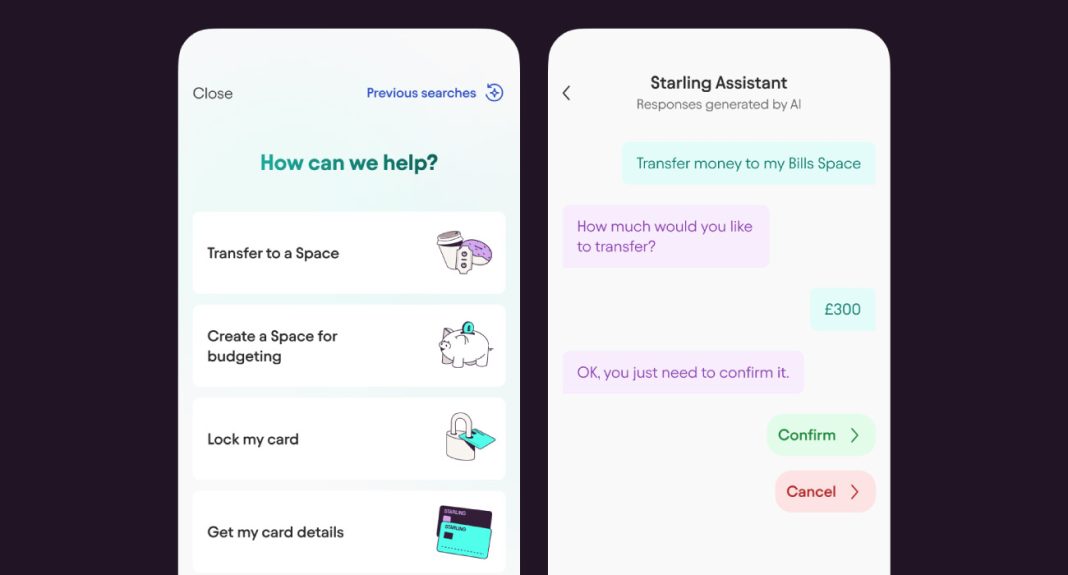


Starling Bank has launched an agentic AI assistant that uses voice and natural language to manage savings, bill payments and budgeting on behalf of its customers.
Starling Bank is rolling out an agentic AI financial assistant, which it says is the first of its kind in the United Kingdom, as the challenger bank moves to put automated money management directly in the hands of its nearly five million customers.
The assistant, called Starling Assistant, responds to voice and natural-language prompts and carries out banking tasks on the customer’s behalf — from setting savings goals and organizing bill payments to offering personalized financial insights and general banking guidance.
The practical scope is specific. A customer planning a holiday could ask the assistant to calculate how much they need to save monthly to reach a target amount by a given date and instruct it to set up automatic transfers to a dedicated savings pot. A customer wanting to organize their finances on payday could ask it to create separate budget categories for groceries, bills, travel and dining out, specifying how much to move into each on a set date each month.
The assistant is built on Starling’s proprietary technology platform using Google Gemini and Google Cloud infrastructure.
Harriet Rees, Starling’s group chief information officer, said the launch represented a new chapter for the bank. “It’s time to embrace a new era of banking, one that’s powered by agentic AI,” she said. “We want to encourage our customers to trust that AI can help them with money management, and we’re excited to be pioneering the use of this technology to help people be good with money.”
Also Read: Your Rebrand Is Failing. Have You Tried Listening?
Starling has been building toward this capability for some time. It previously launched Spending Intelligence, which allows customers to ask natural language questions about their spending habits, and Scam Intelligence, a tool designed to detect online marketplace fraud.
The Starling announcement lands as AI adoption accelerates across European fintech. Klarna uses generative AI for customer service, while Dutch neobank Bunq launched its own AI assistant in 2024. Danish challenger Lunar has said its AI-powered voice assistant will handle around 75% of customer calls over time. Revolut, meanwhile, is exploring a broader push into the AI agent space, with ambitions to automate functions ranging from customer service to sales.