
From LG’s CLOiD to agentic commerce, CES 2026 marked the end of AI as a chatbot and its birth as a physical neighbor—a Martechview analysis by our editors.
If the last two years of technology were defined by the ethereal—data floating in clouds and voices emanating from black boxes—CES 2026 was the year the ghost finally entered the machine.
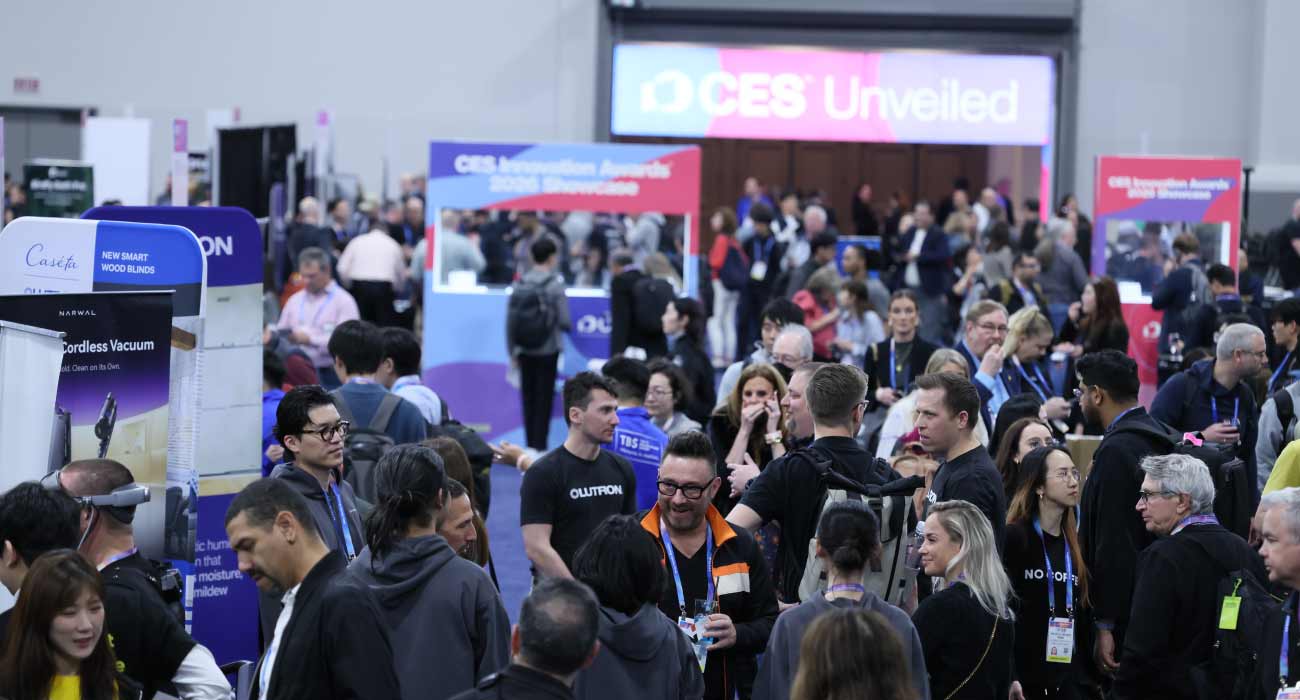
Walking the halls of the Las Vegas Convention Center this week, one didn’t just see “tech.” One saw Physical AI. It is a term we will be hearing for the next decade, championed by the industry’s primary architect, Nvidia’s Jensen Huang, to describe a world where AI doesn’t just think—it does.
The implications are more than just mechanical; they are existential. We are witnessing the birth of a new interface: The Embodied Brand.
The Silicon Foundation: Compute as Currency
The hierarchy of power in 2026 is no longer about who has the best data, but who has the most efficient compute to process it at the “edge.” The keynotes from Nvidia (Jensen Huang) and AMD (Lisa Su) felt less like product launches and more like state-of-the-world addresses.
- Nvidia’s Rubin Platform: The extreme-codesigned architecture behind the 50+ humanoid robots strutting the floor. Huang positioned Rubin as a full-stack “AI supercomputer” rather than just a chip upgrade.
- The “ChatGPT Moment” for Robotics: Huang’s declaration that humanoids have reached their tipping point was backed by the sight of Boston Dynamics’ Atlas—now an electric, commercial-ready product—navigating busy simulated environments with unsettling grace.
Retail’s New Frontier: Agentic Commerce
The buzzword in the C Space at the Aria was “Agentic AI.” This is the bridge between a search query and a physical delivery.
- Agentic Interface: At Microsoft and Google, the focus shifted from assistants that suggest to agents that execute. These systems are now orchestrating tasks across multiple tools without human intervention.
- Lego’s Smart Brick: Perhaps the show’s most charming surprise. By embedding sensors and speakers into the classic plastic brick, Lego is proving that “Physical AI” can transform even the most analog of joys into a data-driven, interactive ecosystem.
The Insight: When the “customer” is an AI agent acting on behalf of a human, the traditional advertising funnel breaks. We aren’t marketing to eyeballs; we’re marketing to algorithms that prioritize utility and reliability over catchy jingles.
Home and Health: The Invisible Assistant
The home is no longer “smart”—it’s anticipatory.
- LG’s CLOiD: This isn’t just a vacuum; it’s a wheeled humanoid that understands the “non-standard” layout of a messy living room. It can open a fridge to check your inventory or load a dishwasher.
- Closed-Loop Wellness: Samsung demonstrated how the Galaxy Ring and Watch now talk directly to your home. If your heart rate indicates deep sleep, the AI-enabled air conditioner adjusts the temperature automatically. This is the ultimate “N=1” personalization.
A New World of Mobility
The “transportation” section of CES has officially outgrown the passenger car.
- Robotaxis are Reality: Waymo and Zoox were the undisputed stars, but the quiet revolution is happening in the “Perfect Turn”—autonomous airport robots from Oshkosh Corporation that fuel and clean planes without human intervention.
- Visual Fidelity: Hisense and Samsung debuted “Creaseless” foldables and RGCB (Red, Green, Cyan, Blue) displays that cover $110\%$ of the color gamut. For brands, this means your “Digital Twin” on a screen will finally be indistinguishable from the physical product.
Our Take
CES 2026 proved that we are moving past “AI Storytelling” into “AI Storyworlds.” The brands that won this year weren’t those with the flashiest booths, but those demonstrating governance and systems.
As we saw in Martechvibe’s own $169\%$ traffic surge in Q4 of 2025, the hunger for understanding this “Physical AI” is voracious. The industry has graduated from the “What is it?” phase to the “How do I control it?” phase. In 2026, the competitive advantage isn’t using AI—it’s using AI with a human hand on the tiller.
The future isn’t just coming; it’s already walking the floor.