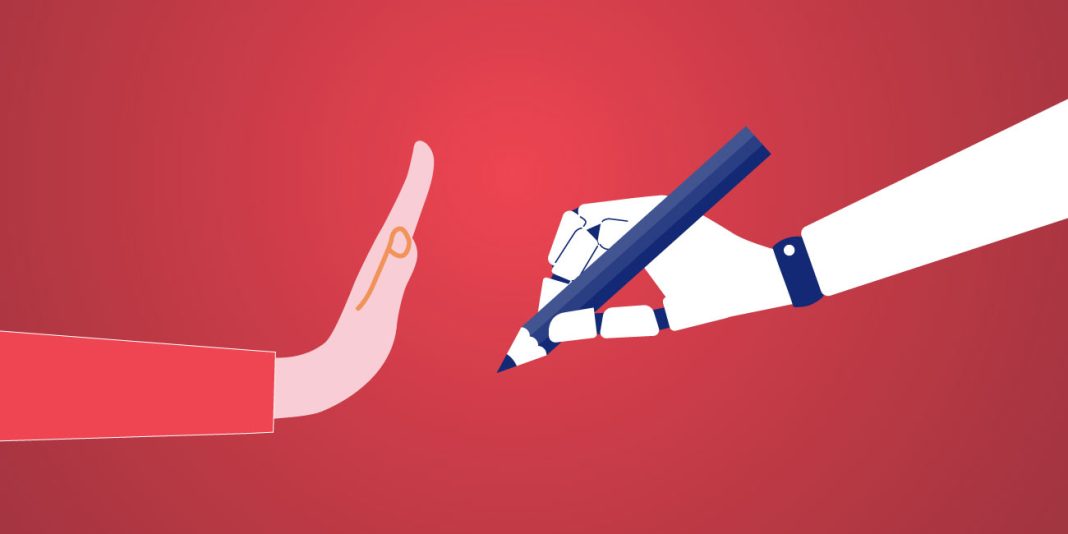

For years, every brand wanted to be seen as an AI company. Now the smarter ones want to be seen as anything but.
Something remarkable has been happening in boardrooms and brand strategy sessions across North America and Europe. Companies that spent nearly three years racing to announce AI integrations, AI-powered experiences, and AI-driven personalization are now doing what would have seemed professionally suicidal in 2023: publicly walking some of it back.
The hot new trend in marketing, it turns out, is hating on AI — or at least being seen to.
This is not a fringe movement. It is a strategic recalibration happening at some of the most commercially sophisticated consumer brands in the world, driven by a simple and increasingly hard-to-ignore insight: in a market saturated with artificial intelligence, the most powerful differentiator available to a brand may be genuine humanity.
The Starbucks Signal
The most striking recent example is Starbucks. In May 2026, the company retired its AI-powered inventory-counting system built by NomadGo across all its North American stores, just nine months after deploying it as a centerpiece of CEO Brian Niccol’s “Back to Starbucks” turnaround strategy.
The problems were operational and embarrassing. Employees and managers across multiple locations described the system frequently miscounting and mislabeling items — confusing similar milk types, missing items entirely during scan sessions, and, in at least one case, failing to recognize a peppermint syrup bottle in a promotional video Starbucks itself had uploaded to showcase the tool. That promotional video, along with the original blog post announcing the rollout, was quietly deleted from the company’s website before the retirement was announced.
At launch, Starbucks had promoted the technology as a way to free workers to focus on what matters: crafting beverages and connecting with customers. The floor reality inverted that promise entirely — the AI system created more work, not less, and the friction showed up precisely at the human moments the brand could least afford to compromise.
For a chain that leans heavily on drink customization and frequent limited-time items, any friction in inventory accuracy can quickly affect sales, waste, and customer satisfaction. Starbucks is not retreating from technology entirely — Niccol is rolling out a generative AI chatbot for staff built on Microsoft’s Azure platform. But the NomadGo failure is a clear signal that AI deployed without operational rigor in a brand built on human warmth and reliability can do more harm than it solves.
Dove’s Decade-Long Head Start
Starbucks may be the most recent and most dramatic example, but Dove understood this dynamic earlier than almost anyone. The brand’s “Real Beauty” campaign, launched in 2004, was built on a single contrarian insight: in a category flooded with aspirational, heavily retouched imagery, showing real women — unaltered, diverse, ordinary in the best sense — would be more commercially effective than following category convention.
In 2024, marking the campaign’s 20th anniversary, Dove formalized what had been an implicit creative principle into an explicit public commitment. “At Dove, we seek a future where women decide and declare what real beauty looks like — not algorithms. Pledging to never use AI in our communications is just one step. We will not stop until beauty is a source of happiness, not anxiety, for every woman and girl,” said Alessandro Manfredi, Chief Marketing Officer at Dove.
The timing was not incidental. As generative AI began flooding advertising with synthetic models, algorithmically optimized faces, and artificial perfection, Dove’s commitment to real images became more valuable, not less. The contrast did the work — and audiences responded.
Also Read: Why the CMO Now Owns the Privacy Problem
The Broader Backlash
Dove and Starbucks are not isolated cases. Porsche released a hand-drawn holiday advertisement with an explicit statement that no AI was used, and it received significant praise in the comments from audiences who recognized and valued the human craft behind it. Polaroid launched a billboard campaign with the line “AI Can’t Generate Sand Between Your Toes,” connecting with consumers on a personal level amid screen fatigue and phone exhaustion.
Aerie made “No AI” a trust promise, extending its long-running no-retouching stance into a clear, modern pledge. Heineken’s “real friends” wearable campaign flipped the AI companionship conversation into an offline invitation.
The year 2025 marked a clear shift, as brands began highlighting human effort and labeling their products “100% human” and “no AI”, labels that are becoming the digital equivalents of “organic” or “non-GMO” in food marketing. Bob Hutchins, CEO of Human Voice Media, described it plainly: “We are at a tipping point where the superabundance of algorithmically-generated content, ‘AI slop, ‘ is making human-generated work a luxury good.”
Merriam-Webster agreed with the diagnosis, designating “slop” its word of the year for 2025.
The Backlash Economy
What these brands are responding to is consumer skepticism that is not a niche concern — it is mainstream, measurable, and commercially consequential.
A Nielsen study found that 55 percent of consumers feel uncomfortable with websites that primarily use AI-generated content, and 4 out of 5 said brands and media organizations should be transparent about their AI use in content creation. A 2025 study from the Nuremberg Institute for Market Decisions found that simply labeling an ad as AI-generated makes people see it as less natural and less useful, lowering ad attitudes and willingness to research or purchase.
The market, in other words, is creating a premium for authenticity precisely because authenticity has become scarce. When something abundant becomes rare, its value rises. Human-made, genuinely considered communication was once the default. AI has made it exceptional almost overnight — and the brands that recognize this before their competitors do will capture a meaningful and durable advantage.
The Risk of Overcorrection
It would be a mistake, however, to read this as a simple rejection of AI. The brands navigating this moment most effectively are not the ones abandoning technology entirely. They are the ones being selective and transparent about where AI adds genuine value and where it subtracts human value.
Starbucks, notably, is not walking away from AI — it is walking away from AI that failed operationally and degraded the human experience on which its brand depends. Dove is not anti-technology; it has created Real Beauty Prompt Guidelines to help people use generative AI more responsibly and inclusively. The distinction is not AI versus no AI. It is a judgment about where each belongs.
Also Read: Hyper-Automation Is Over. Agentic AI Is What Comes Next.
What Comes Next
The irony at the center of this moment is rich. The technology that promised to make marketing more efficient, more personalized, and more effective has, at scale, made it less trusted, less differentiated, and less human. And the brands that spent the most aggressively to automate their way to relevance are discovering that the most relevant thing they can do right now is slow down, show up as people, and say something worth saying.
Starbucks is retooling its in-store operations to put human connection back at the center. Dove is running photographs of real faces. Porsche is hiring animators. Polaroid is putting up billboards about sand between your toes.
The slop, as Merriam-Webster put it, “oozes into everything.” And the brands pulling back from it are finding that the space they reclaim is worth considerably more than what they gave up.
The AI arms race is not over. But the counter-movement has started — and, in marketing, as in most things, it’s where the most interesting money gets made.