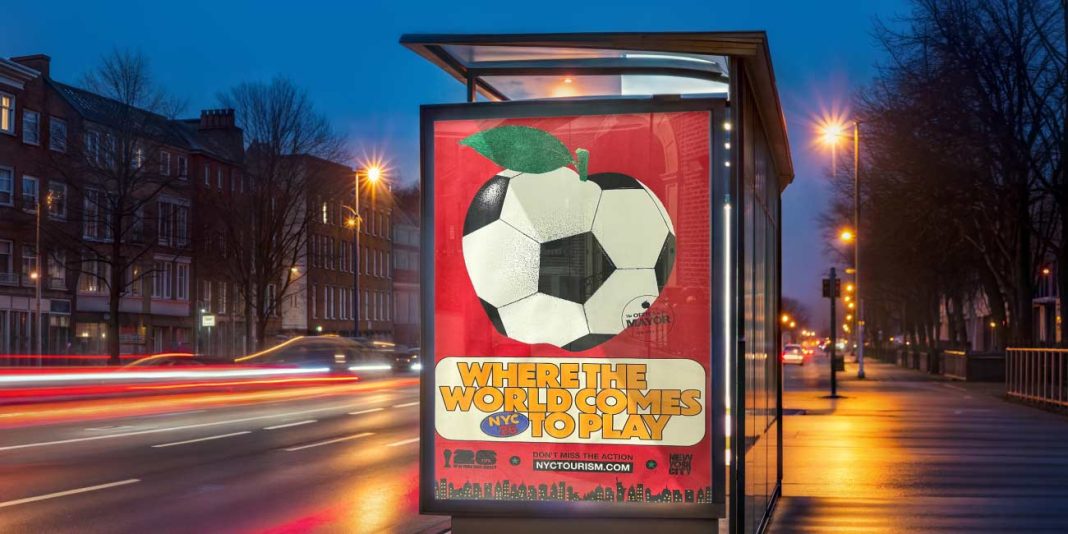

From Adidas and Nike to LEGO and Dove, brands are spending billions not to sell products, but to become part of football culture itself.
Modern sports marketing has officially graduated from the era of product placements and aggressive calls to action. With WARC Media forecasting a $10.5 billion uplift to the global ad market during this tournament quarter, the world’s biggest brands are executing a masterclass in a discipline entirely different: selling things without actually selling them.
It’s worth pausing on that $10.5 billion figure because it tells a more interesting story than it first appears. WARC’s own analysts describe it as just a 1.1% incremental lift over a normal year, once inflation is stripped out — smaller, in fact, than the $12.6 billion bump the 2018 Russia tournament generated. In other words, most of this money isn’t new spend flooding into advertising. It’s existing budgets being redirected, with unusual intensity, toward proving cultural fluency rather than buying reach. As WARC Media’s Head of Content, Alex Brownsell, put it, brands today are expected to engage fans “across touchpoints before, during and after matches,” not just during the live broadcast.
That shift in spending logic is matched by an equally deliberate shift in creative strategy. Instead of interrupting the fan experience to pitch a product, brands are positioning themselves as essential facilitators of the fan ritual — leaning into the high-stakes drama, humor, and collective anxiety that defines international football. By building interactive digital communities, orchestrating physical creator hubs, and poking self-aware fun at tournament regulations, marketers are embedding their logos directly into the emotional memory of the games.
The scale of the moment they’re embedding themselves into is hard to overstate. This is the largest World Cup ever assembled — 48 teams, 104 matches, 16 host cities, and 39 days of competition between June 11 and July 19. FIFA expects around 6 billion people to engage with it globally, and roughly 1.5 billion to watch the final. As the tournament scales to that unprecedented 48-team format across the United States, Canada, and Mexico, a hyper-localized, social-first approach ensures brands aren’t just shouting from the sidelines. They are capturing a massive, hyper-engaged audience by proving they understand the sport’s culture as deeply as die-hard supporters in the stands do.
Here are the five campaigns dominating the 2026 World Cup by doing exactly that.
Adidas: “Backyard Legends”
Arguably, the blockbuster campaign of the tournament. Created by LOLA USA and directed by Mark Molloy through SMUGGLER, this cinematic five-minute film stars Timothée Chalamet as a hyper-serious street football recruiter tasked by musician Bad Bunny to assemble a ragtag squad capable of taking down an undefeated neighborhood crew that hasn’t lost a match in thirty years.
The Strategy: It masterfully blends generations, featuring current icons like Jude Bellingham, Lamine Yamal, and Trinity Rodman alongside brilliantly integrated, AI-de-aged legacy players like David Beckham and Zinedine Zidane. It stands out because it ditches the typical corporate “glorious destiny” tone and makes football feel playful, nostalgic, and accurate to grassroots fandom.
The bet appears to be paying off: Adidas has already sold roughly $292 million in 2026 World Cup products, and CEO Bjørn Gulden has called the U.S. the brand’s biggest long-term opportunity.
Lay’s: “Bandwagon”
Lay’s focused its massive budget on solving a uniquely North American marketing tension: appealing to a massive audience that doesn’t traditionally watch soccer.
The Strategy: In their “Jump On, America” spot, comedian Will Ferrell drives a literal yellow-branded Bandwagon across the country, jokingly onboarding confused citizens into football fanaticism alongside David Beckham and Marshawn Lynch. By reframing “bandwagon fan” from an insult into an invitation, they strip away intimidating sports gatekeeping and pair the ad with limited-edition, globally inspired chip flavors like Argentinian Style Steak with Chimichurri.
The timing is shrewd: a Full Circle Research study found that 75% of Americans plan to follow the 2026 tournament, many of whom are not traditional football fans — exactly the audience “Bandwagon” is built to recruit.
LEGO: “Everyone Wants a Piece”
LEGO leaned heavily into peer-to-peer social distribution rather than traditional broadcast buys, generating hundreds of millions of views by treating elite sports rivalry with blocky, lighthearted humor.
The Strategy: Created by LEGO’s in-house team alongside Wieden+Kennedy Amsterdam, the campaign features stop-motion brick versions of Kylian Mbappé, Cristiano Ronaldo, Vinícius Jr., and Lionel Messi sitting around a rotating table, taking turns assembling a massive LEGO World Cup trophy. It leans into a clever running gag that there is only room for one of them at the top of the brick pyramid, capturing the tournament’s high stakes through miniature, nostalgic animation.
The payoff was immediate: the campaign generated 314 million views across the players’ Instagram accounts within 24 hours of release, with fans calling it a moment “generations will talk about.”
Nike: “Rip the Script”
Nike delivered a hyper-stylized, high-energy cultural tribute to the emotional roller coaster of international football, designed to capture the sheer unpredictability of the 2026 tournament.
The Strategy: Featuring a powerhouse lineup including Kylian Mbappé, Erling Haaland, Cristiano Ronaldo, and even a crossover appearance by LeBron James, the campaign avoids focus-group-tested corporate hype. Instead, it plays out like a fast-paced montage of fan culture, perfectly capturing the anxiety and chaos of tournament cycles — from group chats blowing up to the collective nerves of a nation anticipating either a historic victory or a dramatic penalty-shootout exit.
Dove / Unilever: “The Game Is Ours”
As an official personal care sponsor of the tournament, Unilever launched a massive sports partnership, but Dove’s purpose-led sub-campaign is the one driving the most meaningful cultural conversation.
The Strategy: Rooted in the insight that one in two girls quits sports due to body-type criticism, the hero film is uniquely built entirely out of the raw, joyful audio and sounds of girls playing the sport, which swells to drown out the voice of critics. Backed by “House of Fresh” physical creator hubs across major host cities, it intentionally shifts the spotlight away from elite, untouchable multi-millionaire athletes to advocate for confidence and belonging at the grassroots level.
The Bigger Picture
Taken together, these five campaigns point to something larger than clever creative. Industry analysts note that not a single crypto firm sits among FIFA’s headline global partners this cycle — a sharp reversal from Qatar 2022, when Algorand held a marquee sponsorship — suggesting brands are gravitating toward cultural credibility over speculative association. Meanwhile, Fox and Telemundo are projected to generate a combined $850 million in World Cup ad revenue, a figure that, for the first time in American soccer history, edges the tournament into Super Bowl territory.
The lesson for marketers without Adidas or Nike-sized budgets isn’t the dollar figures. It’s the discipline behind them. Each of the brands above chose one coherent theory for how to win attention and spent accordingly. In a tournament this fragmented, that clarity, more than the size of the check, is what’s actually winning.